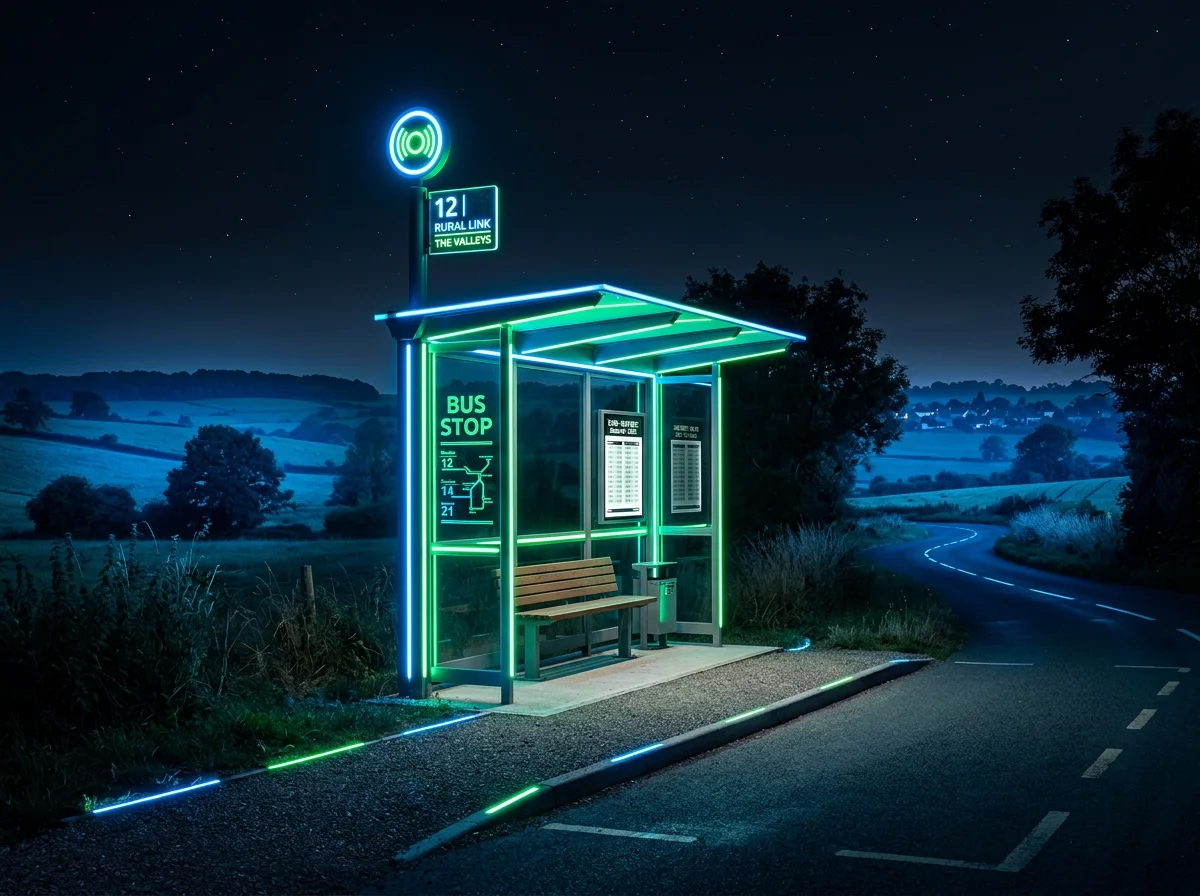
The context
In rural municipalities, school bus shelters are often installed along secondary roads, far from village centres and out of reach of the public electrical grid. In winter, children wait for the bus in the morning darkness and sometimes return after nightfall. Passing vehicles travel at regular speed.
The problem is simple: how can the bus shelter be made visible — to the children who use it as much as to the drivers approaching it — without imposing on the municipality the cost of an electrical connection (often tens of thousands of euros for a few metres of use) nor that of a solar battery to be replaced every five years?
Our solution
luciolles installs luminescent marking on and around the shelter: entrance marking on the ground, perimeter signage, highlighting of structural angles, approach marking for vehicles.
The materials combine three products from the range: photoluminescent paint for horizontal marking, luminescent gravel embedded in a resin for the approach ground, and luminescent elements on the shelter walls to signal its presence in the night-time landscape.
The whole system operates through passive daylight absorption. No cable, no battery, no solar panel. The shortest winter day provides enough charge to cover the following morning’s school wait.
The observed results
The first benefit is perceived safety. For children, the shelter is no longer a black spot in the night-time landscape: its outlines, entrance and ground are legible. For parents, the child’s presence is signalled — they are seen, and they know they are.
For drivers, the approach ground marking works as a continuous warning. The luminescent signage flags the waiting area well before headlights reach the shelter itself, and invites a reduction in speed.
For the municipality, the benefit is as budgetary as it is technical. Installation takes one day, without intervention from the public grid, without civil works, without a connection agreement. There is no electricity bill to provision, no battery to renew, no moving part to monitor.
This configuration — rural area, no electricity, intermittent use, vulnerable users — is one where luciolles technology best expresses its value. What could not have been equipped for lack of budget becomes equippable, cleanly, for the material’s lifespan.
The model applies equally to other isolated points: seasonal stops, off-grid rest areas, access to peripheral facilities, hamlet exit pathways.