The context
Cycle paths and walking trails often cross natural, agricultural or peri-urban areas. Connecting them to conventional public lighting raises three issues: the cost of trenches over several kilometres, light pollution in sensitive areas (night-time wildlife, forest edges), and the permanent electricity consumption.
Local authority demand has shifted: no longer to light the path, but to make it legible. To let cyclists or walkers follow the route, at night, without imposing a curtain of lampposts on the landscape.
Our solution
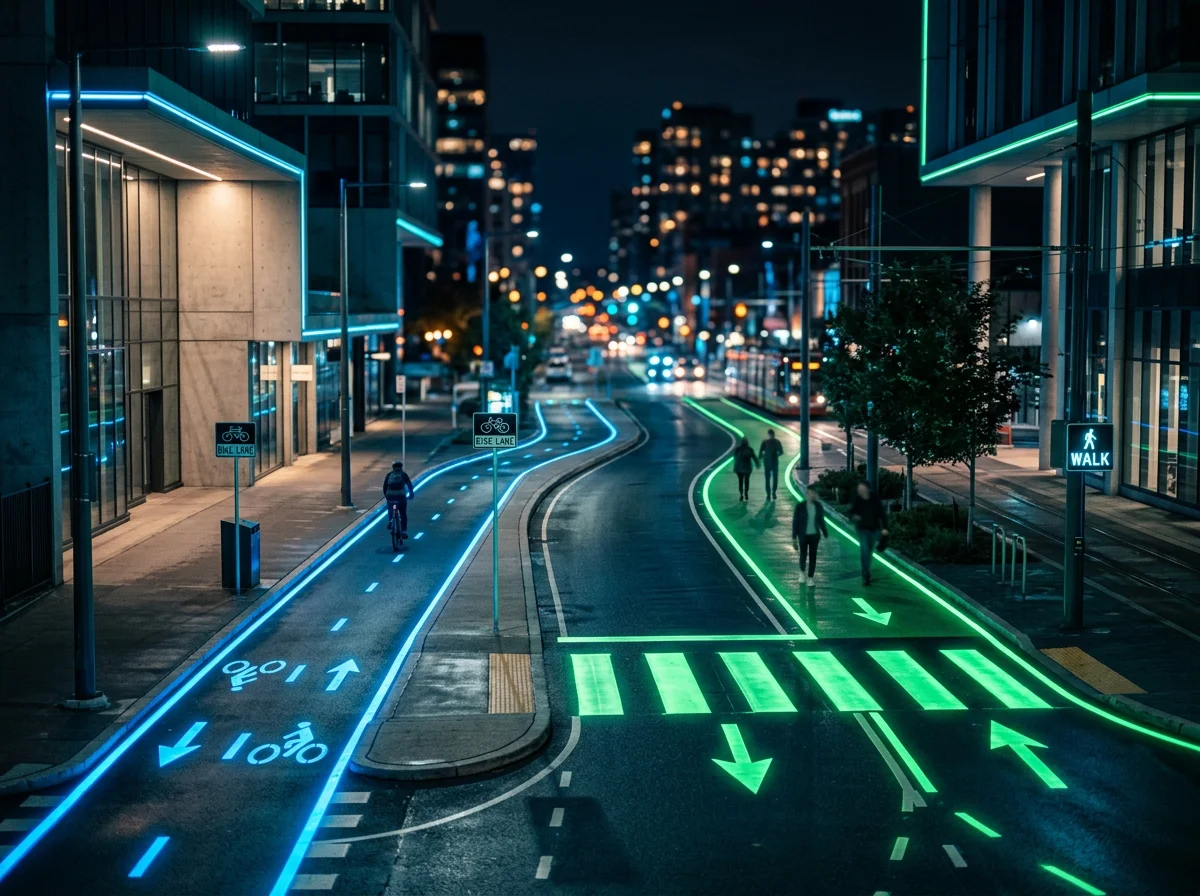
luciolles applies a luminescent gravel resin on the path. The resin acts as a binder, the photoluminescent gravels capture and release the light. The marking follows the layout — central axis, edges, side strips — according to the geometry defined by the client.
Installation is cold, using standard road resin applicators. No connection, no electrical equipment, no trenches.
The gravel adds a second function: grip. The surface retains a roughness compatible with regulatory requirements for cycle and pedestrian paths, without becoming slippery in wet weather.
By day, the resin blends visually with the pavement: the marking is sober, mineral, compatible with the graphic charters of urban planning. As dusk falls, the gravels release the light they captured during the day.
The observed results
On the equipped sections, the marking remains legible for several hours after dusk — well beyond the typical time frame of night-time journeys. The cyclist’s and walker’s eye finds its bearing on the ground, without glare, without halo.
Savings occur on two levels. On investment: no electrical grid to extend, no lighting civil works. On operation: no consumption, no source replacement, no scheduled maintenance.
For protected areas, the ecological gain is immediate. The absence of vertical public lighting preserves the movement corridors of night-time wildlife. The low, directed light emitted by the gravels does not interfere with biological cycles.
Luminescent marking finds its place on greenways, inter-urban cycle paths, walking trails in natural areas, marked hiking routes. Wherever the function calls for night-time legibility, without justifying the footprint of permanent lighting.