The context
The five products in the luciolles range cover the most common uses — concrete, markings, parking, infrastructure, memorial. But the photoluminescent technology itself — a mineral material that captures daylight and releases it at night — knows no strict boundary. It applies anywhere an element must be made visible in the dark, without being connected to the grid.
Every week, we receive requests for off-catalogue projects: heritage signage, integration into furniture, technical identification, artistic use, non-standard safety marking. This page exists to gather these requests and show that bespoke work is an integral part of our practice.
Our approach
For off-catalogue requests, our design office opens a technical dialogue with the project lead. Three questions guide the conversation: what is the intended use? what is the implementation environment (indoor, outdoor, traffic, climate)? what is the expected service life?
From these parameters, we point toward one of the luciolles formulations — paint, gravel resin, exposed aggregate concrete, mineral inclusion — or propose an adapted combination. In some cases, we develop a specific variant: pigment tone, aggregate size, particular mechanical resistance.
The final deliverable can be an adapted standard product, a bespoke element, or manufacturing assistance for partners who integrate luminescence into their own products.
Explored use cases
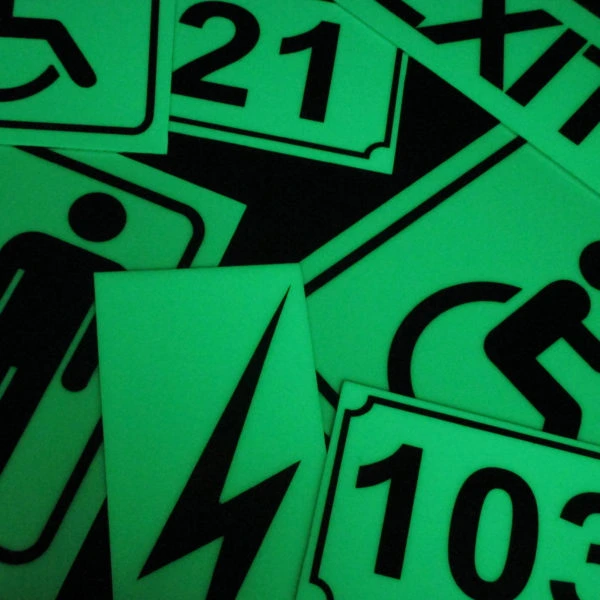
Some projects move beyond the strict framework of floor marking and yet find a natural place in the range: heritage signage in fragile natural sites, night-time tagging of isolated technical equipment, decorative elements in gardens and parks, safety markers in public buildings without permanent lighting, stair and step nosing markings.
Others sit at the boundary of design and engineering: urban furniture with luminescent inlay, artistic objects for temporary installations, exhibition scenography elements. The technology adapts to fine integration, as long as the material can be exposed to daylight.
Expected results
Whatever the use, the four benefits of luciolles technology remain constant: no energy consumption after installation, no scheduled maintenance, no electronics to monitor, no light pollution.
For the project lead, this translates into minimal operating cost and a service life aligned with that of the integration material. For the end user, it delivers a discreet, stable luminous presence that asks for nothing.
If you have in mind a project that the five previous categories do not cover, let’s talk. Our design office is here to turn an idea into matter — and matter into light.